


Want to give a huge shoutout to Salman Sohani, a former classmate of mine in undergrad that works Growth at Kalshi for inspiring this week’s spotlight. Check him out to learn more about Kalshi and his amazing thought leadership!
The founding story: turning curiosity into a regulated market
Kalshi was founded in 2018 by Tarek Mansour and Luana Lopes Lara (former professional ballerina btw), two MIT grads and absolute quant demons who bonded over a shared question: why can people invest in stocks, commodities, or currencies, but not on the outcomes of real-world events that actually drive those markets?
They had seen how everyday decisions and forecasts rely on probabilities. Elections, inflation reports, rate decisions, GDP prints, new product launches, even weather patterns constantly shape business results. Yet there was no regulated financial instrument that allowed someone to directly hedge or express a view on these outcomes.
So they built one.
Kalshi became the first federally regulated events exchange in the United States, approved by the CFTC. That approval process took years, dozens of legal battles, and more scrutiny than most fintechs face in a decade. But it paid off. Today, Kalshi lets traders buy and sell contracts on questions like:
Will the Fed raise rates at the next meeting
Will inflation come in above a certain percentage
How many jobs will be added in Friday’s payroll report
Will a major tech company hit a product milestone this quarter
Each contract settles at either zero or one dollar depending on whether the event happens, which creates a clean, binary trading experience centered on information, probability, and timing.
Kalshi’s goal is ambitious. They want to build a brand-new asset class, where information becomes a tradable product and forecasting becomes a market activity rather than a guessing game.

What Kalshi actually does
At its core, Kalshi is an events futures exchange, regulated similarly to the CME or CBOE. However instead of trading soybeans, lean hogs or interest-rate futures, users trade on the outcomes of real-world events.
This creates a new way to:
Hedge exposure to uncertain outcomes
Speculate based on research, data, or expertise
Price probabilities more accurately than polls or predictions
Tap into markets that historically had no financial instruments
An example is inflation. Companies and individuals regularly deal with inflation risk, but hedging it usually requires complex instruments like TIPS or rate swaps. On Kalshi, someone can simply buy a contract that pays out if CPI comes in above the expected level.
But it can go beyond all of that boring stuff as well. Not sure if you saw all the publicity, but with NYC electing a new mayor was all the rage. One side there was a youthful, charming fellow named Zohran, and then we had Andy Cuomo, that ran into some Sean “Diddy” Combs level allegations in 2021.
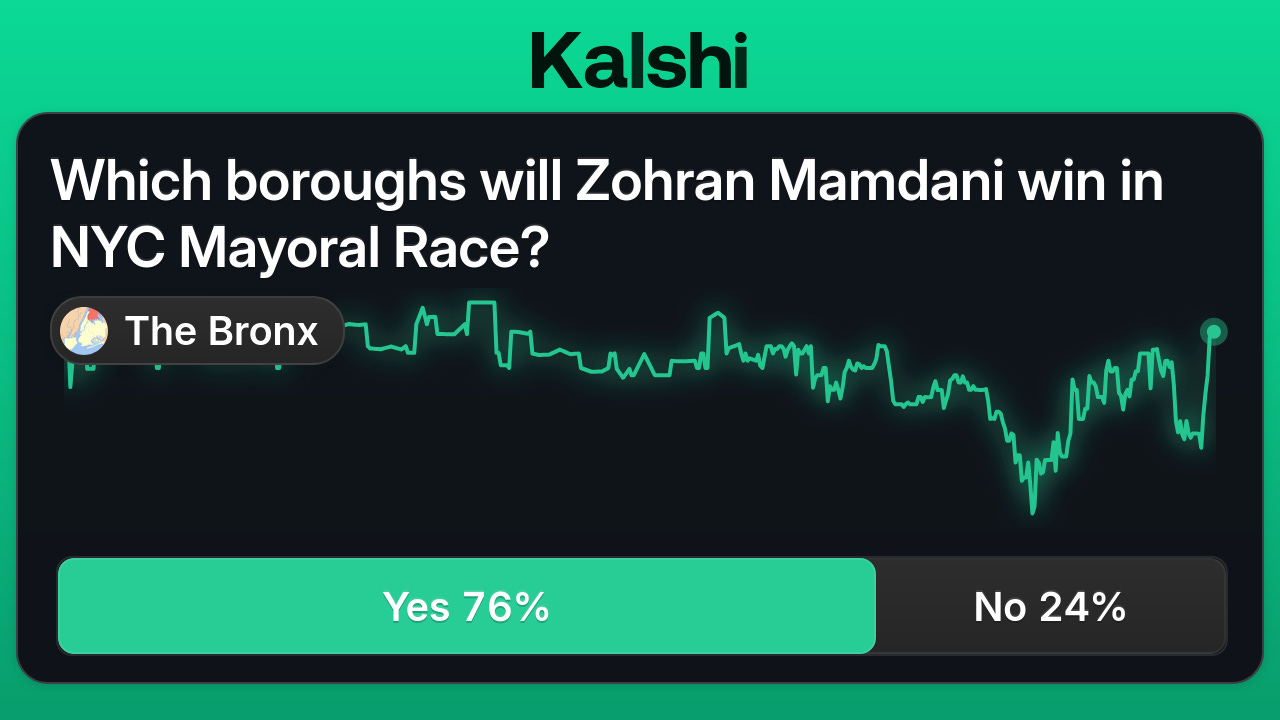
Kalshi is attempting to take the idea of prediction markets, clean them up, fully regulate them, and position them as a legitimate part of the financial system.
The vision is bold. If they succeed, “event contracts” could become as common as stock options.
Funding and team at a glance
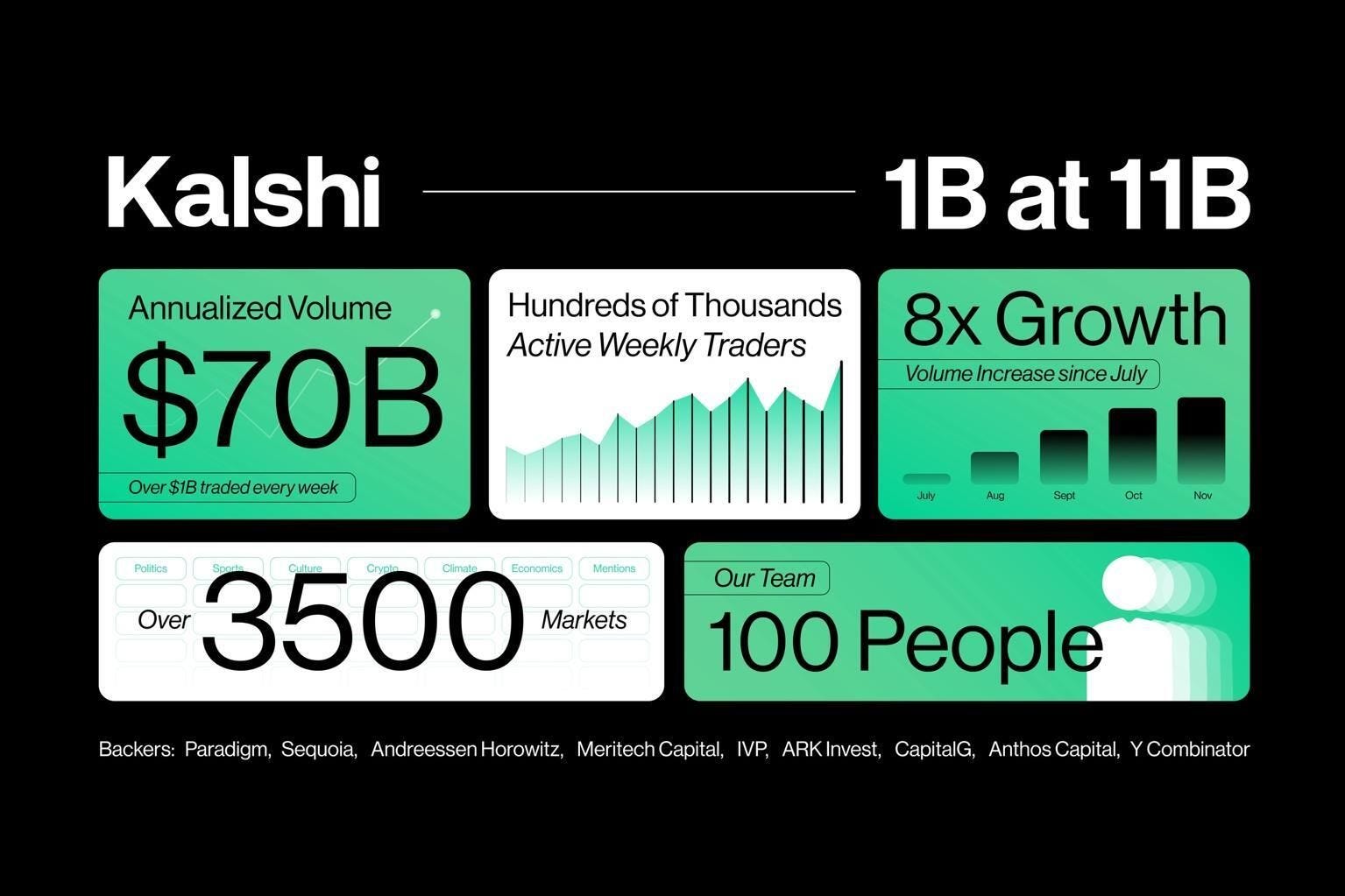
💰 Just recently raised $1B at an $11B valuation from investors including Paradigm, Sequoia Capital, AH, and more, literally 2 months after they raised $300M
🏦 First fully regulated events exchange approved by the CFTC
👥 Team of 100+ employees
🌎 HQ: New York, NY
🖥️ Website: kalshi.com
The competition and how Kalshi compares
Kalshi sits in a unique position. Most “prediction markets” operate in grey areas or as hobbyist platforms. Some adjacent competitors include:
Polymarket
Crypto-based prediction market with large volume but limited regulation.
PredictIt
Popular for political markets, but constrained by regulatory restrictions.
Manifold
Runs more of a social prediction economy using virtual currency.
These platforms are fun and have strong communities, but they cannot support institutional money or regulated hedging activity.
Kalshi’s biggest differentiator is legitimacy. They are the only events exchange with federal approval, which means they can build markets that serious traders, institutions, and risk managers can use.
That regulatory moat is massive. In a world where markets are shaped by data and uncertainty, Kalshi wants to become the place where information has a price. And unlike consumer prediction apps, Kalshi is treating this like a financial product from day one.
Partnering with major media: Kalshi data becomes part of the news cycle
CNN has begun integrating Kalshi event market data directly into its election coverage, using real-time probability signals from Kalshi to help viewers understand how key political outcomes are shifting. CNBC also struck a partnership with Kalshi to incorporate their prediction data across their networks.
This is a big deal for a few reasons.
First, it shows that event markets are becoming part of mainstream information flows. Election coverage usually leans on polling, expert commentary, or models from places like FiveThirtyEight. Now, Kalshi is providing a live financial signal that reflects what traders believe the most likely outcomes are at any given moment.
Second, it validates Kalshi as more than just a trading platform. They are positioning themselves as an information engine. The probability data generated from Kalshi markets is becoming a resource that media organizations can use to explain complex events in a clearer way.
Third, it pushes prediction markets into the public consciousness. When a major media outlet like CNN or CNBC broadcasts Kalshi data, it normalizes the idea that markets can price real-world events with accuracy and transparency.
In short, this partnership helps Kalshi transition from a niche fintech to a mainstream forecasting tool. When your probability curves are being shown on national television, you are clearly shifting how the public thinks about prediction, uncertainty, and the future.
My take
Kalshi sits at one of the most interesting intersections in fintech: the overlap between financial infrastructure, regulatory innovation, and the psychology of prediction.
Personally, I find their concept fascinating because so much of our professional and personal decision making hinges on events we cannot control. The idea that you can hedge those moments or profit from your expertise is incredibly powerful.
Kalshi is growing like a wildfire, and their regulatory moat, strong founding team, and growing liquidity make them one of the most compelling fintech stories to watch right now.
If you care about markets, economics, or the future of trading, keep Kalshi on your radar. They are building something entirely new, and that does not happen often.
🧭 Kalshi Roles
These are some pretty cool roles at Kalshi in the moment. I encourage you to keep in tune with future LaunchPad job posts to see any new exciting roles that pop up at Kalshi and many other cool firms!
That’s a wrap on Spotlight #21
If you made it this far, thank you for reading! I hope these spotlights help you discover companies worth your time, and make the job hunt feel just a little bit less overwhelming. Keep an eye out for next Tuesday’s LaunchPad job drop, and if you know someone looking to break into tech or level up, feel free to share this with them too.
Here’s to building something cool, or better yet, joining something cool. 🚀
